
The best AI OKR software for mid-market ops teams (2026 guide)

Written by
Brev Team
Reading time
5 min read
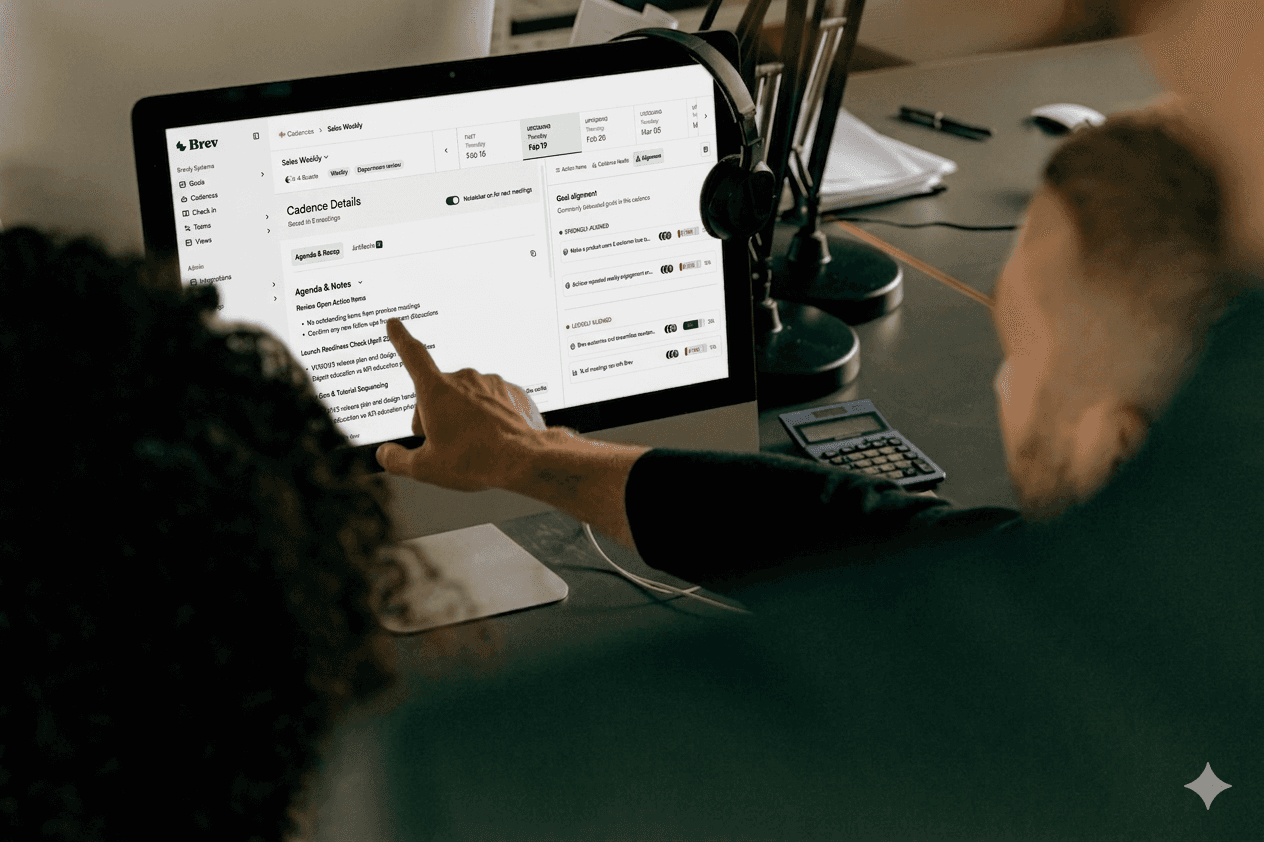
The best AI OKR software for mid-market ops teams isn’t necessarily the biggest platform or the one with the longest feature list. It’s the one that reduces the work instead of adding to it.
Mid-market ops leaders — typically running companies with 200 to 1,000 people — have a specific problem: they’re too big for spreadsheets and too resource-constrained for enterprise software that requires a 3-month implementation. The right AI OKR software lives in that gap.
Here’s what that looks like in practice.
Why mid-market teams need AI OKR software specifically
At 50 people, you can manage OKRs in a shared doc. At 200+, that approach breaks. You’ve got multiple teams, multiple goal trees, multiple stakeholders — and no single person with the bandwidth to chase updates from all of them.
That’s the gap AI OKR software fills. Instead of relying on human memory and weekly reminders, AI agents monitor progress automatically. When a key result falls behind, it surfaces the risk. When action is needed, it generates the recommendation.
For a Chief of Staff or VP of Ops at a mid-market company, this changes the job from “OKR administrator” to “decision-maker.” That’s a meaningful shift.
What to look for in AI OKR software for mid-market teams
Native integrations with your existing stack
Mid-market companies don’t have unlimited engineering resources to maintain custom integrations. Look for AI OKR software with native connections to the tools you already use: Salesforce, HubSpot, Slack, Linear, GitHub, Google Drive.
These integrations aren’t just convenient — they’re the mechanism for automatic progress tracking. Without them, you’re back to manual updates.
Fast setup, not a project
Mid-market teams need to be live in days, not months. If your AI OKR software comes with a 6-week onboarding project, it was built for enterprise customers with dedicated implementation teams — not for a lean ops function trying to move fast.
Brev is designed to connect and deploy quickly, with no implementation project required. Most teams are up and running with live goal tracking in under a week.
AI that acts, not just observes
The difference between AI OKR software and traditional OKR software is what happens when something goes wrong.
Traditional tools show you a red indicator. AI OKR software tells you why it’s red, which team or initiative is responsible, and what action is most likely to get it back on track. That’s not a minor upgrade — it’s the whole value proposition.
Brev’s AI agents do this across all six product surfaces: goals, cadences, actions, team digests, and meeting intelligence. When a goal slips, the action item is already waiting for approval.
Meeting-native, not meeting-separate
For mid-market ops teams, the weekly business review and quarterly cadence are where goals live or die. AI OKR software that doesn’t integrate into those meetings is missing half the value.
Look for tools that auto-generate meeting agendas from goal data, extract action items, score meeting quality, and push outputs back into the goal tracking layer. The best AI OKR software makes every meeting shorter, faster, and more actionable.
Goal context for AI agents (MCP support)
There’s one more capability worth evaluating in 2026: whether your AI OKR software can feed your goals to the AI agents working alongside your team. Platforms that support Model Context Protocol push your live goals, metrics, and progress into Claude, Codex, Cursor, and the CLI — so every AI output starts from the same strategic context your ops team is working from. Brev MCP does exactly this, which is why we describe Brev as an execution system for humans and agents too.
Mid-market AI OKR software comparison
Brev — Built for mid-market. AI agents handle automatic tracking, meeting prep, and action items. 12+ native integrations. Fast onboarding. The most automation-forward option in the category for teams that don’t want to babysit their goals.
Lattice OKRs — Works well if you’re already on Lattice for performance management. Manual progress updates are still the default; limited AI capabilities. Better for HR-centric goal tracking than ops-centric execution.
Quantive — Excellent methodology, complex implementation. Designed for large enterprises. Most mid-market teams find it over-built and expensive.
Ally.io / Microsoft Viva Goals — Deprecated in 2024. Not a viable option for new deployments. Teams on this platform should migrate — and AI OKR software is the logical next step.
The ROI case for AI OKR software at mid-market scale
Gartner research consistently shows that goal alignment is a top driver of organizational performance — but most companies struggle to maintain it at scale. The problem isn’t strategy. It’s the ops overhead of keeping goals alive.
AI OKR software eliminates that overhead. A conservative estimate: if AI tracking saves your ops team 5 hours per week across the goal management function, that’s 250+ hours per year redirected to higher-value work. At mid-market compensation levels, that’s $30–40k in recaptured capacity — and that’s before counting the decisions made faster because goal data was actually current.
The best AI OKR software for mid-market teams is the one your ops leader stops thinking about because it just works. See how Brev does it, or read more from the blog on how mid-market teams are restructuring their ops rhythm with AI.
Start with Brev today and get $100 in free credits when you sign up — claim your credits here.

Stay in the loop
Get execution insights, product updates, and OKR playbook, delivered to your inbox.
You may also like these
Related Posts


